
Liquid Gas Week 2026 in Istanbul: what the global LPG industry said about supply, Africa and data
From 12 to 16 October 2026, the World Liquid Gas Association brought more than 2,000 LPG industry representatives from over 110 countries to Istanbul. Three messages stand out: global supply is under strain and the International Energy Agency is studying a security mechanism for LPG, clean cooking in Africa remains the sector's main social priority, and data is moving into the distribution chain. For Cameroon, which imports most of its household gas, all three play out right down to the kitchen.
What is Liquid Gas Week?
Liquid Gas Week is the annual meeting of the World Liquid Gas Association (WLGA), which brings together the global liquefied petroleum gas (LPG) industry. The 2026 edition took place from 12 to 16 October at the Istanbul Congress Center, the first time in Türkiye, under the theme “Resilience in a Changing World” (LP Gas Magazine, 12 October 2026). According to Habertürk (15 October 2026) (in Turkish), it brought together more than 2,000 industry representatives from over 110 countries.
The official programme covered the whole chain: the association's working meetings and general assembly, a technology conference, a day on markets and global trade, an autogas day, sessions on safety, clean cooking and digital tools, and a science conference on renewable LPG on the Friday. The WLGA puts global LPG consumption at about 380 million tonnes.
Why supply security dominated the week
The week opened in a market under pressure. In his keynote on 14 October, Fatih Birol, Executive Director of the International Energy Agency (IEA), said global LPG prices were on average 60% above their level before the war in the Middle East, and that more than a third of global LPG trade passes through the Strait of Hormuz, mostly to Asia (Anadolu, 15 October 2026).
Above all, he noted that slightly more than half of the LPG consumed worldwide is used for cooking and heating in homes, so the crisis hits households directly. The IEA is discussing with governments and industry a security mechanism specific to LPG, modelled on the emergency oil stocks the agency can release to the market when supply is disrupted. The idea extends the clean cooking security programme the IEA announced in July, focused on LPG storage and supply chains (Climate Home News, 10 July 2026).
Türkiye's Energy Minister, Alparslan Bayraktar, struck the same note: “We cannot afford to depend on a single energy resource, a single supplier, technology or transportation route,” he said (Daily Sabah, 14 October 2026). In his view, LPG, which is portable and needs little infrastructure, is valuable during supply disruptions and natural disasters.
On the industry side, Melih Poyraz, CEO of Aygaz and WLGA Vice President, described global LPG stocks at an unprecedented low. Even if the war ended, he said, rebuilding them would take time, and the Far East and Africa would keep feeling the effects in 2027 (Habertürk, 15 October 2026, in Turkish).
What was said about clean cooking in Africa?
Africa had its own place on the programme. On Tuesday 13 October, the WLGA's Cooking For Life Africa Task Force held an invitation-only workshop, supported by the IEA, on LPG's role in clean cooking access: regulatory frameworks, financing mechanisms, infrastructure and market models for underserved communities. The next day, a “Scaling Clean Cooking in Africa” round table brought together TotalEnergies and the LPGas Association of South Africa, among others, on the policies, investment and market development needed (official programme).
The orders of magnitude the WLGA set out earlier this year show what is at stake: about 900 million Africans lack access to clean cooking fuels, nearly four in five people in Africa cook with firewood or charcoal, and LPG has driven around 70% of global clean cooking gains since 2010 (LP Gas Magazine, 18 February 2026).
In Istanbul, Alparslan Bayraktar recalled that about 2 billion people worldwide still lack access to clean cooking, and that Türkiye wants to bring the issue to COP31 in Antalya in November. He also set out what scaling up requires: affordable supply, safe equipment, reliable distribution networks and cooperation between governments, industry and international institutions (AzerNews, 15 October 2026).
For the WLGA, 2026 is the year its Cooking For Life programme moves “from exploration to implementation”, with Africa as a priority, Melih Poyraz explained in an interview the association published in January. He also noted that LPG was recognised for the first time as a clean cooking fuel in a G20 Leaders' Declaration (WLGA, 22 January 2026).
Data, the new link in the chain
Less visible than the opening speeches, another thread ran through the week: data. On Thursday 15 October, a “Digital Intelligence & Data Advantage” session, led by the WLGA Youth Council, brought together tank telemetry specialists (Anova, Gasbot, Sensile Technologies) and an Argus analyst around three questions: what digital tools already do, what holds adoption back, and what scales from one region to another. The technology conference on 13 October also featured automation and embedded systems specialists, from Aygaz to Bharat Petroleum (official programme).
The same session hosted the final of the World LPG Challenge, the WLGA's start-up competition: three finalists from Portugal, South Africa and the United States pitched their solutions to an audience that chose the winner (official programme). The winner's name had not been published as of 22 October.
The technology conference awards, published on 20 October, point the same way. The AI, digitalisation and IoT category went to Italy's TCL Group, operations improvement to Makeen Energy and Anova, and decarbonisation and health to Brazil's Ultragaz. The safety and product quality award went to TrackAbout, software from Datacor that reads the markings stamped on LPG cylinders from a photo (serial number, manufacturer, test date) and keeps a dated record of each cylinder, useful in disputes over its ownership, location or condition (LP Gas Magazine, 20 October 2026). Knowing where each cylinder is and what state it is in: that is the question every industry built on cylinder recirculation asks, Cameroon's included.
Safety followed the same logic. With millions of new users joining every year, the “Simply Safety” session stressed that training consumers and staff across the whole distribution chain is becoming essential (official programme).
What it means for Cameroon
The three messages from Istanbul read directly in Yaoundé and Douala. Cameroon imports most of its LPG, and the strain of September 2026 showed what happens when supply tightens (our article of 2 October). In the very week of Liquid Gas Week, SCDP announced in Kribi the upcoming foundation stone of the Kribi Hydrocarbons Terminal and recalled its new storage spheres in Bonabéri (SCDP, 13 October 2026, in French; see our article on storage and logistics).
If global stocks stay low in 2027, every imported tonne will have to be allocated better. This is where data from the last link becomes useful. Depot stocks are known; what is left in households' cylinders is not. MyGaz measures that level: the UltraSense sensor, placed under the cylinder, estimates it by ultrasound, the UConnect box sends it over the mobile network, and the MyGaz app shows the household the estimated days left. The delivery agency sees needs coming, and the web console gives distributors and marketers a view of demand by neighbourhood.
MyGaz measures the gas level, not leaks. Safety still rests on compliant cylinders, licensed filling plants and good habits at home, set out on our gas safety page.
Next stop: Houston in 2027
The next Liquid Gas Week will take place in Houston, in the United States, from 8 to 12 November 2027 (Liquid Gas Week). Until then, two milestones are worth following: COP31 in Antalya in November, where Türkiye wants clean cooking on the agenda, and what the IEA does next with its proposed LPG security mechanism. The MyGaz pilot network is starting in Yaoundé; marketers, distributors and partners who would like to talk can write to the team from the Contact page.
Sources
LP Gas Magazine, “Liquid Gas Week 2026 launches in Istanbul”, 12 October 2026.
Liquid Gas Week, official programme “Schedule at a Glance”, read on 19 October 2026.
Daily Sabah with Anadolu, “Türkiye stresses need for diversified energy sources amid global shocks”, 14 October 2026.
AzerNews, “Istanbul hosts first-ever World Liquid Gas Week, spotlighting LPG security”, 15 October 2026.
Anadolu Agency, “IEA considers LPG security mechanism amid energy crisis”, 15 October 2026.
Habertürk, interview with Melih Poyraz, CEO of Aygaz (in Turkish), 15 October 2026.
Climate Home News, “Iran war fuel shocks threaten Africa's clean cooking push, IEA says”, 10 July 2026.
LP Gas Magazine, “WLGA calls for LPG to be central to global energy agenda at IEA meeting”, 18 February 2026.
WLGA, “The Voice Of Melih Poyraz, CEO of Aygaz and WLGA Vice President”, 22 January 2026.
LP Gas Magazine, “TrackAbout wins Innovation Category Award at Liquid Gas Week 2026”, 20 October 2026.
Liquid Gas Week, announcement of the 2027 edition in Houston, read on 19 October 2026.
SCDP, “La SCDP se tourne vers Kribi” (in French), 13 October 2026.
Read next
All news Household LPG: after the strain, Cameroon turns to storage and logisticsAfter the sharp strain on household gas in Yaoundé and Douala in September 2026, Cameroon's LPG industry announced measures in October focused on storage and transport: a coordination meeting in Douala on 8 October, then SCDP's depot managers' seminar in Kribi on 13 October, with a hydrocarbons terminal in Kribi and an energy hub in Bonabéri on the horizon. These projects strengthen the upstream part of the chain. The last link, the cylinder in the kitchen, still has to be made visible.
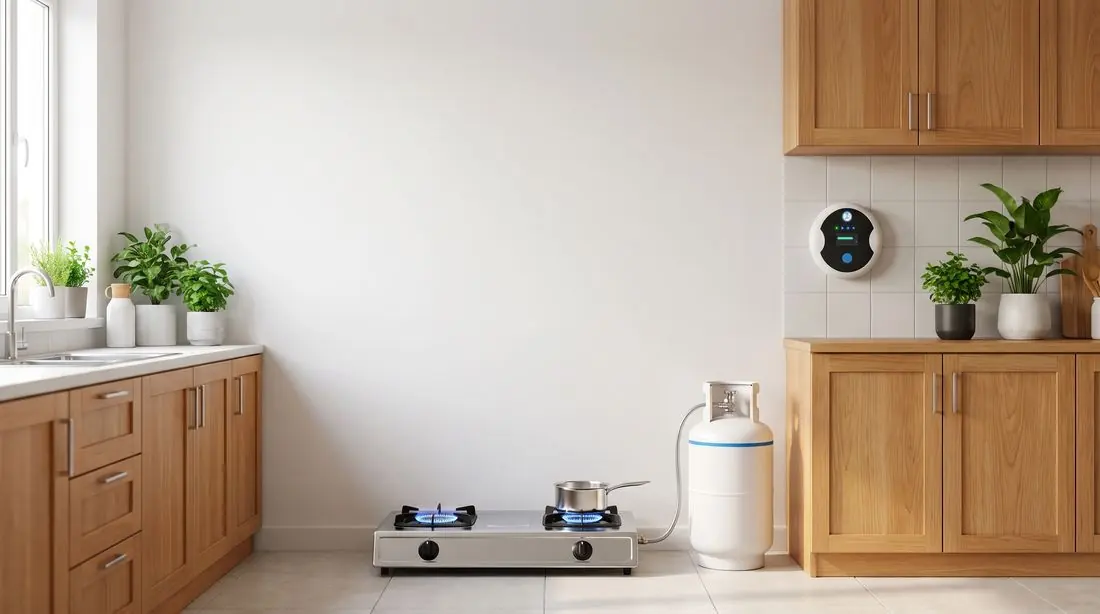 Household LPG in Cameroon: why connect the cylinderIn September 2026, households in Yaoundé and Douala went from one sales point to the next looking for cooking gas. Demand is rising, local output has dropped and Cameroon imports most of its LPG. A connected cylinder does not create gas, but it tells everyone how much is left: MyGaz, in Yaoundé, makes that level visible to the household, the delivery agency and the industry before the cylinder runs dry.